Same Energy, Different Arena: How IPL Fandom Is Changing the Way Desi Americans Follow Bollywood
It's 11 PM on a Tuesday in a group chat called 'MI FOREVER 🏏🔥' and things have gotten heated. Not about a match — IPL season wrapped weeks ago. The argument currently consuming seventeen desi Americans across four time zones is whether Shah Rukh Khan's recent magazine interview was a calculated PR move or a genuine moment of vulnerability, and whether that changes anything about his standing relative to Salman Khan in the pantheon of '90s Bollywood giants.
The debate has footnotes. Someone has pulled up a 2009 awards show clip as evidence. A spreadsheet of box office numbers has been shared. There is, at this point, no meaningful difference between how these people are engaging with celebrity culture and how they engage with cricket.
Welcome to the Bollywood-cricket pipeline — and it's more real than you might think.
The Tribal Blueprint
To understand what's happening here, you have to understand what cricket fandom actually does to the South Asian psyche. It doesn't just create fans. It creates allegiances — deep, identity-level loyalties that organize how you see the world, who you trust, and who you're willing to argue with at a family dinner.
In India, cricket has functioned as a kind of secular religion for generations. Team loyalties, player worship, the anguish of a bad series and the ecstasy of a World Cup win — these aren't casual interests. They're formative experiences that shape how people relate to collective identity, competition, and belonging.
Desi Americans carry that blueprint with them. And when they arrive in a country where cricket barely registers on the cultural radar, that tribal energy doesn't disappear. It finds other outlets.
Bollywood is the most natural one.
Stats, Stans, and Scorecards
What's striking about how desi American communities engage with Bollywood fandom is the rigor of it. This isn't passive celebrity gossip consumption. It's analytical. It's competitive. It's organized in ways that would be immediately recognizable to anyone who's ever participated in a fantasy cricket league.
Box office opening weekend numbers get debated with the intensity of batting averages. An actor's career trajectory gets mapped across years the way a cricket analyst might chart a player's form across series. When a film flops, the post-mortem in the group chat can go for days — examining the trailer strategy, the promotional tour, the choice of release date, the co-star chemistry.
"I have friends who literally made a Google Sheet comparing the last five SRK releases against comparable Aamir Khan releases, adjusted for budget and marketing spend," says Rohan, 29, a product manager in San Francisco. "The same guys also run a fantasy IPL league. The energy is identical. I don't think they've noticed."
The IPL Effect on Bollywood Beef
Here's where it gets particularly interesting: the IPL — with its franchise tribalism, its team loyalties, its Twitter wars between fanbases — has provided a structural model for how desi Americans now organize celebrity feuds.
The SRK-Salman dynamic? That's basically Mumbai Indians vs. Chennai Super Kings energy. You pick a side, you defend it with your life, you acknowledge certain objective facts about the other camp while maintaining that your guy is fundamentally superior, and you never, ever switch allegiances publicly without an explanation.
The same applies to newer generational debates — Ranveer vs. Ranbir, Deepika vs. Alia, whatever the current discourse happens to be. The framework is sports-tribalism, applied wholesale to entertainment fandom.
Social media has turbocharged this. Twitter and Instagram have given desi fan communities the same kind of real-time, public, competitive arena that sports commentary has always occupied. A Bollywood celebrity's post can generate the same kind of immediate, stat-citing, clip-pulling discourse that a controversial umpiring decision does during a big match.
The Watch Party Evolution
Another place where the crossover is visible: the watch party.
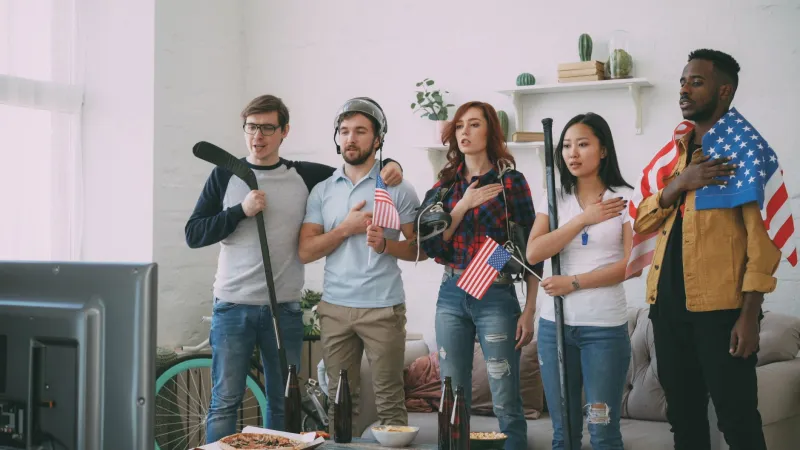
IPL watch parties have been a fixture of desi American social life for years — groups gathering at someone's house or a local Indian restaurant to watch matches together, with all the noise and passion that implies. What's newer is that the same format has migrated to Bollywood.
Major film releases, awards shows, and even the occasional controversial trailer drop are now generating organized watch events in desi American communities — complete with the group reactions, the running commentary, and the post-event debate that used to be reserved for cricket.
When Pathaan released on Amazon Prime in the US, desi group chats coordinated simultaneous watch times so people could live-text each other through it. The experience was indistinguishable from watching an India-Pakistan match together — the anticipation, the real-time reactions, the collective processing of something that felt bigger than just entertainment.
Celebrity-Athlete Crossovers Are Accelerating This
The pipeline runs both ways, and the entertainment industry knows it. Bollywood's increasing entanglement with cricket — SRK's ownership of the Kolkata Knight Riders, celebrity appearances at IPL matches, the whole ecosystem of cricketers dating or marrying Bollywood personalities — has made the two worlds functionally inseparable for many diaspora fans.
Virat Kohli and Anushka Sharma aren't just a celebrity couple. They're a merger of two fandom universes, and their combined following operates with the intensity of a super-fan coalition. In desi American spaces, following one often means following both, and the communities around them have blended accordingly.
For entertainment brands and Bollywood PR teams, this is significant. The desi American fan who came for the cricket stayed for the celebrity drama, and vice versa. The audience is the same audience.
What This Means for How Desi Culture Gets Built in America
Zoom out a little and what you're seeing is actually something profound about how South Asian Americans are constructing community in the US. In a country where cricket doesn't air on mainstream television and Bollywood exists at the margins of mainstream pop culture, desi Americans have built their own parallel fandom infrastructure — complete with its own media ecosystem, its own influencer class, its own debate culture.
And the tribal instincts honed through decades of cricket passion are the operating system running underneath all of it.
The group chat called 'MI FOREVER 🏏🔥' is still going, by the way. The SRK debate has been tabled — temporarily — because someone just posted a clip from a 2003 Filmfare interview that they claim changes everything.
The spreadsheet is being updated.