Neither Here Nor There — And That's the Point: Meet the Desi Artists Inventing a Sound All Their Own
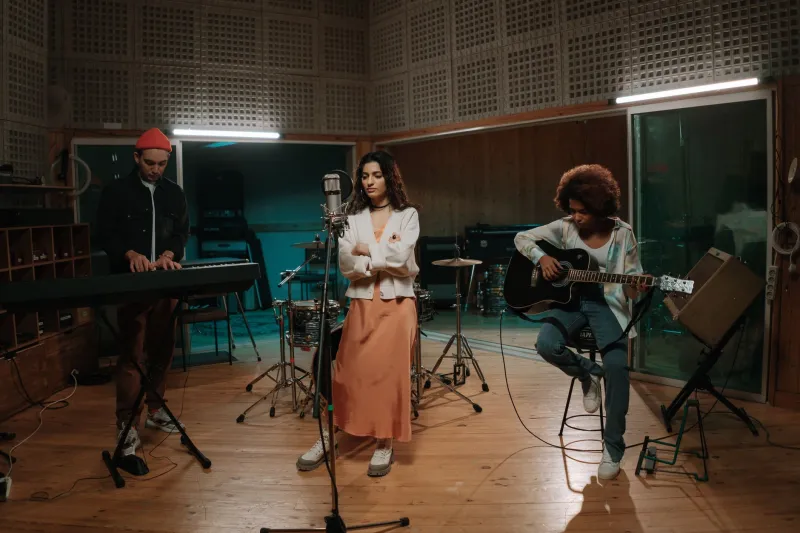
Open Spotify and search for "South Asian indie" and you'll find something that didn't really exist five years ago: a sprawling, genre-defying constellation of artists who sound like nothing you've heard before — and somehow everything you've always felt.
There's a sitar looped under a bedroom pop track. There's a Carnatic vocal run winding through an R&B beat. There's a ghazal melody stretched over a synth pad that wouldn't be out of place on a Bon Iver record. This is the new desi sound, and it isn't coming from Mumbai. It's coming from Brooklyn, from Atlanta, from the Bay Area, from college towns and apartment studios across the United States.
For years, "Desi music" in America meant one of two things: Bollywood, or Bhangra at the campus culture show. Both are genuinely wonderful. Neither is the whole story. What's emerging right now — from a generation of South Asian American artists who grew up with one foot in each world — is something more complicated, more personal, and honestly more exciting.
The Hyphen Is the Instrument
Ask any of these artists about their influences and you'll get a list that makes a music teacher's head spin. Ravi Shankar and Frank Ocean. Nusrat Fateh Ali Khan and Phoebe Bridgers. Lata Mangeshkar and SZA. The hyphen between "South Asian" and "American" isn't a limitation for this generation — it's the instrument they're playing.
Take Meera Iyer, a 24-year-old Tamil American singer-songwriter based in Brooklyn who releases music under the name Meerawave. Her debut EP blends Carnatic vocal training — something she spent years studying in her parents' living room — with lo-fi production and English lyrics that feel pulled from a journal. "My classical training is in everything I do, even when nobody can point to it," she says. "The way I approach a melody, the way I think about microtones — that's all Carnatic. But the emotional world I'm writing from is very much my life here, in New York, being 24 and figuring things out."
Her track "Amma's Radio" went quietly viral on Instagram Reels last spring, with thousands of South Asian women in the comments writing things like "she said what I couldn't" and "I played this for my mom and we both cried."
Breaking Out of the Culture Show Box
For a long time, South Asian American musicians who didn't fit neatly into Bollywood or Bhangra categories had limited pathways to visibility. You could compete in talent shows, perform at cultural festivals, maybe land a YouTube cover that got passed around the community. But the mainstream music industry didn't have a clear shelf for you.
That's changing — partly because of streaming platforms that have flattened the gatekeeping, and partly because the audience has grown up. Diaspora listeners who once had to choose between their desi identity and their indie music taste no longer have to make that call.
"My parents wanted me to be the next A.R. Rahman," laughs Kabir Anand, a 27-year-old producer and multi-instrumentalist from the Bay Area who goes by Kabir.wav. "What I actually became is something they didn't have a word for at first. Now my mom sends my music to her friends. It took a minute."
Kabir's production style pulls from Hindustani classical structures — particularly the concept of raga, or melodic frameworks tied to time and mood — and runs them through electronic production techniques. The result sounds like something you might hear in a thoughtful indie film score, except it's also deeply, unmistakably rooted in a tradition that goes back centuries.
The Playlist That Doesn't Exist Yet
One of the challenges for this emerging scene is discoverability. These artists often don't fit neatly into Spotify's algorithmic categories. Are they world music? Indie pop? Alternative R&B? The answer is usually "yes, and also none of those."
Some are building their own infrastructure. Collectives like Brown Girl Magazine and community-driven playlists on Spotify curated by desi music fans are doing the work that major labels and streaming algorithms haven't caught up to yet. Artist-run newsletters and Substack pages are building direct relationships with listeners who are hungry for exactly this kind of music.
Nisha Patel, a music journalist and DJ based in Houston who runs a South Asian music blog called Raag & Roll, has been tracking this scene for three years. "What's happening right now reminds me of what happened with indie folk in the early 2000s — a bunch of artists who had no obvious commercial lane were just making the music that felt true to them, and eventually the world caught up," she says. "I think we're in that pre-breakthrough moment for South Asian indie in America."
What Comes Next
A few things are clear. This scene is growing. The audiences are hungry. And the artists themselves aren't waiting for permission from Bollywood or the mainstream industry to define what desi music can be.
Meera puts it best: "I used to feel like I had to explain myself — like, yes, I studied classical music, yes, I also love Mitski, yes, both things are real. Now I just make the music and let people find it. The ones who get it, really get it."
For DanBhai readers who've spent years toggling between their parents' playlists and their own, this moment feels personal. These artists are making music for the space between — and it turns out, a lot of us live there.
Artists to Check Out Right Now:
- Meerawave — Amma's Radio (EP)
- Kabir.wav — Raga Hours (single)
- Prism Collective — Between Seasons (album)
- Anika Rao — Monsoon Bedroom (EP)
- Zara & the Tabla — Rewire (single)
Stream them. Share them. Tell your group chat.